Showing posts with label Alex work. Show all posts

everyday improvements

I've given up on trying to talk Alex into sitting back and relaxing in a quiet anchorage for a lengthier time as creating something, building or fixing or simply doing something at all times clearly is what his mind requires. 

It's a double feeling for me of course, who often love to kick back, enjoy the moment and analyze and discuss or plan future ideas and the worlds all problems preferably with a nice glass of wine in hand. Especially now that I've spent approximately 50-60 hours a week slaving working since October last year and I almost was about to give my right arm away for a full week or two of snooze. 

But on the other hand, Alex's determination to constantly improve and work on physical (or musical) projects consistently makes our home and world a little better, stronger, safer and nicer so for that I am always very thankful of course. It also gives me all the time I need and require for reading, writing, meditating, working on my newest endeavor and whatever else that I find so important for my soul. 

Thinking about it, I think Alex's strong work ethics and his constant strive for physical improvement in our living space might be one of the most crucial reasons to why our relationship and life in such small space works as well as it does. It gives us ample time off each other, even when we literally spend most time together if that makes sense. That sort of character goes well with my personality, who need and enjoy spending most hours of the day alone. It does get frustrating from both sides in different ways occasionally obviously, but in the big picture I think the constellation is what make things work so well as a whole. And with time it feels we've learnt to manage and adapt to each others very different sort of needs. Eg: me lending a helping hand whenever he needs it, and he being more conscious about putting tools and other miscellaneous stuff away once he's done.

What you see in the image above is the frame of the new cockpit table that he's made in teak which has been glued and assembled, temporarily fixed to the saloon table. Going to be marvelous to finally have a proper table to dine on also outside. 

The boat doctor

If Alex would have got paid for each time he's guided or helped people with their boats and their equipment, we would be rich and have that dodger on our boat long time ago. He's like a traveling sailboat doctor, and boat and sailing wikipedia in one, working pro bono in 80% of the cases. But on the other hand, we have cashed in several new friendships this way, and quite a few free drinks and dinners hehe.. No but honestly, I've lost counting on all those boats he's rescued, rigs he tensioned (on this particular Philip L. Rhodes Bounty II that is our neighbor today for example), hulls he repaired, people he taught about fiberglass fabrication, gearbox/fuel system repairs, electrical connections and installments and other general know-how he's shared. It also helps that he's fluent in all the major sailing languages around here, French, English and Spanish.

I really hate being the silly wife continuously bragging about her oh so fantastic husband cause I know how nerdy and pretentious it sounds (we're not even married but you get the point), and truth be told my man has many flaws, too, just to let you know, but if we keep to the subject, he has as a matter of fact been the lifesaver of many a boat-owner and somehow we always seem to attract people in need of assistance around us.

One evening in Prickly Bay in Grenada a few months ago for example, just when our friend Michael had arrived if you remember, and we had just enjoyed a filthy little peanut-butter cup dinner the three of us if my memory doesn't fail me, we heard a big BANG on the hull. What the fuck?! We all rushed out, only to find a 40 something feet catamaran dragging its mooring buoy in the 30+ winds that were that night, hitting our hull and continuing to drag backward into several other boats on its way, quickly closing in on the reef behind.

Alex, the fast thinking alien that he always is when it comes to this sort of drama, jumped into our dinghy, shot off to the rapidly dragging cat, jumped onto the bow, grabbed a couple fenders, set them up for following shocks, grabbed the next boat at anchor that the cat passed by, secured the cat in this other boat and got the engine started (owners had forgot to switch off the starter battery). All to avoid the catamaran destroying more boats and itself on the way towards the merciless reefs just a hundred meter away. This was a pitch dark night, 30+ wind and all this action happened within five minutes of the crash into our boat. Of course the owners of the catamaran who were ashore dining this evening were very happy to find their boat safely anchored a bit further down the bay, very close but not quite on the reef, just like we would have been if it would have happened to us. At sea it is so very important to be alert, and as devastating accidents can happen to anyone, we must always look out for the ones that are in need of assistance. You remember the last time something dramatic happened to us? So thankful we got the help we needed in just the right moment. 

Bulkhead up

All plywood parts are ground, grooved and shaped. Here spreading the filler into the grooves. 
Alex chose to carve out grooves in parts of the plywood to achieve a better mechanical bond, particularly in places where it will be hard to glass around. Like on the level of the drawers, as we had no will to dismount and tear apart the whole interior.
Another biscuit joint to bond the existing half bulkhead with the new extension.
Mixing up more filler.
Screwing in place.
And there the whole new bulkhead is up. Almost done now. Now remains only carbon tape and fairing, before painting and a mahogany trim that is going to be installed. More to follow...

Slowly transforming

While I am normally busy editing images or reading my Spanish books in the evenings, as a part of my regular every day job and general education, Alex is often glued to his yacht design books or busy drawing new plans for the boat. Many sleepless nights have been spent on his part since we got Duende and still there's a long way to go before we for sure know that this boat is as safe and seaworthy as we need her to be. Why is Alex building new frames, floors and bulkheads you might ask? Doesn't every sailable boat come with them already in place? Yea, one would hope that at least those are where they should, but somewhere along the line of owners since Halsey Herreshoff sold his designed race boat (in which he himself sailed and raced in the mid seventies) - there has been some alterations done by different hands. We've earlier mentioned that the interior is beautiful to look at, but unfortunately while that new joinery was put into place some ten or fifteen years ago, many ribs, frames and bulkheads have simply been cut and removed to make room for new installations. Like I said, the interior looks beautiful at most parts and it's well made from an artistic point of view, but because we want and need a seaworthy boat, these alterations were the first ones on our list to be repaired. 

I have also mentioned before that we have experienced some flexing of the hull while sailing, and that obviously comes from the lack of a solid, strong structure, which was somewhat destroyed by the alterations that have been done in recent years. As you might know, Alex has now spent the first year with this boat restoring the missing bits and pieces. There are the new stringers and frames under the aft cabins. A new chainplate and framing has been added to the transom. During the haul out in Antigua last year, Alex added a few new floors in the mid-section, in front of the mast under the head which I have yet to show you. There are the floors, bulkhead and frames that've been built at the bow, as well as the latest structural addition added under the companionway. This means that most of it is now done and the boat feels stiffer and stronger by the day, but there still remains two very important jobs to be completed before we can fully trust and feel confidence in this boat. One of those are to rebuild the steel mast step, and the other job which Alex just started: to extend the half bulkhead which is in front of the mast in between the head and our cabin, to a full bulkhead to give more stability. There certainly is a big job in restoring this boat to her original glory as well as to add the extra features which slowly transforms this yacht from a light and fast race boat to a, still fast, but also safe and seaworthy offshore cruising boat. I am currently sorting out the photos from the past years refit and will soon show you all steps from the above mentioned work that Alex has put into Duende thus far. 

New coamings

While most of the hull reinforcement job is done (will show more photos from it one of these days) there are still a long list of smaller things to take care of on the boat. This is what Alex has been occupied with the last couple days. He removed some old wood inside of the coamings and replaced it with plywood and cedar. Luckily the outer part made of mahogany was intact so only neccesary to deal with parts of the inside. It's almost done now and Alex will be glassing it tomorrow. Little by little he's ticking of tasks from the long list..

Stringer and bulkhead job aft bunks

I started project "reinforcement" to avoid high point load and because the boat was flexing a bit too much. This was clear from day one when we purchased the boat so I knew I just had to dig into it... Here in one the two aft bunks. I have here removed a rotten mini bulkhead/frame which also wasn't tabbed properly. I've grinded a large area for the new stringer and the new bulkhead that I planned to put in here on each side. 
Cutting plywood/new bulkheads.
1/2" marine plywood.
Night has arrived.. cutting stripes of foam for stringers.
Four layers of each around 10 mm stripes of foam glued together and glued to hull. This is before shaping.
Shaped and in process of filleting with epoxy and filler.
One layer of Biax and one of UD. 
Here's the stringer finished before painting. That's two layers of Biax, three of UD and I used Peel-Ply partly to avoid having to sand before painting.
Morning after, bulkheads to be put in place. I've cut some vent through them and shaped them by the corners.
Glued and fillet.
Tabbed and plywood sealed.

Haven't painted the area yet but shall do so when all floor work is finalized. Boat is slowly feeling stiffer with this and the other recently done reinforcements. Showing you the other parts shortly. /Alex

tools

If you ever wonder why Alex wanted to change to a bigger boat.. well it was definitely not because of my lightweight shoes. Do you have any idea of how much these things weight? One can wonder how the hell we have crossed an ocean with all these boxes, tools and everything else that are inside of our boat, and we did that with a 35ft back then, remember. Luckily there are many compartments on this new boat where these boxes can be hidden when not in use, not like on the old boat where it literally felt like we lived inside of an overloaded workshop. I can't say that we share the boat building passion, Alex and I, but I'm still glad to have these things around, the refit of Duende would have been much more expensive in case Alex wouldn't have all these tools to work with. I know many of you are curious to see what has been done on the boat in the past few months and I'll get back to you with some photos from the refit in a few days. We're currently on our way towards St Maarten where we'll stay some days before heading down South. Very excited to finally be on the way again.

Does all of you sailors have all these things onboard?

New chainplate

The old backstay chainplate was mounted inside of the lazarette and giving unnecessary extra load to the transom, which of course, with the years had got bended improperly inwards. Alex removed that old chainplate and built a new one in 1/2 inch (12,75 mm) stainless steel that is mounted on the outside of the transom instead of inside. The chainplate is cut from a 316L steel plate and has been bent under heat. The process of bending it, drilling the holes (countersunk) and polishing of the plate took Alex around 12 hours in total. The chainplate is now fastened with six bolts, two of them has encapsulated nuts inside of the new plywood knee which is glassed in place. The four remaining bolts goes through the knee and the transom. Will show you the inside and the glassed knee when that space is tidied up if that could be of interest. Just too bad that we need to remove the boats name from the back and move it somewhere else on the hull, but at least we've got the backstay issue out of the way and the transom has slowly been forced back into its right shape. This installation should definitely give a more even load to the transom.
This is how the boat looked from the back before the new chainplate installation. Nice from a far with the name clearly visible, but not so safe nor good for the construction cause if you looked close enough, you could clearly see that the whole transom was being pulled inwards by the old chainplate. 

Work in progress

The mainsheet traveler was only one of all the things that we have found out wasn't accurately installed on our 'new' boat, good for us that it hadn't had an opportunity to break before we noticed. A furiously flying boom is never a good thing on a boat, we can do without that type of disaster. Here's Alex making the backing plates he wants to install to support the track. Glad we have free access to one of the best boat workshops in the Caribbean here in Antigua so we can get all those very important details properly done.

Carbon design

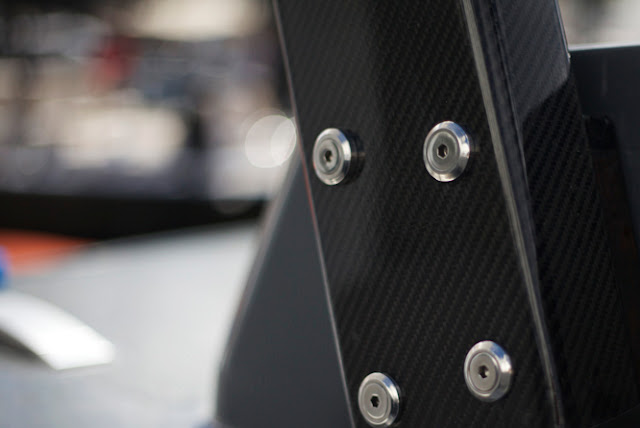
So this is one of Alex's latest design creations. A paddleboard rack made in carbon fiber, mounted on a Goldfish 36, one of the fastest RiB dinghies in the world. I'm sure many of you know what carbon fiber is and what it is used for but for you who don't have so much knowledge, I'd like to explain what I have learned during this process and tell you why this fiber is widely used and loved by engineers and designers in many industries. Carbon fiber is composed mostly of carbon atoms which are bonded together in crystals. Carbon fiber is a super strong material, five times stronger than steel, two times as stiff yet weights about two-thirds less. The fiber is basically very thin strands of carbon, much thinner than human hair, which is twisted into a yarn or woven into a cloth and can thereafter be used as it is or bought in stiff panels. When building up a surface or a permanent shape from the cloth (or twill), it can be laid over mold and then coated with layers after layers of a bonding agent like epoxy resin, and sanded in between coats, all done in pretty advanced and time consuming manners as what you aim for is a super sleek and glossy surface. 

Due to the lightweight and stiffness this fiber offers, it is incredibly popular in the sailing racing world, if not used for the complete boat, well enough for parts of it like the mast, boom, rudder and many other parts of the yacht. Compared to other common building materials like fiberglass, kevlar and wood, carbon fiber remains as the most expensive and not everyone can justify the high cost it is to produce from this fiber. 

Just a little fact that I found out while doing my research, we all know that most components of a car are made of steel right, imagine if they were made of carbon fiber instead, the cars would decrease their weight by around 60% and in turn this would reduce the cars fuel consumption by 30%. While reducing weight, the cars could also be built with smaller, more efficient engines or have the engines completely replaced with electric engines resulting in massive fuel savings. Fantastic for the environment but unfortunately the material is way too expensive. The cost of carbon fiber per pound is around $10, compared to steel which goes for less than one dollar a pound. But given the fact that carbon fiber had a price of $150 only ten years ago, the price development looks promising for the future. Another downside is unfortunately that the material isn't as easy to recycle as steel, just another problem to solve before it can be put into widespread use in cars.

The dinghy which this rack now is mounted on, is made at the most part of carbon already, so of course they needed a paddle-surfboard-rack matched in the same material. The paddleboards (can carry eight at a time) are to be laid (with cover of their own bags of course) on top of this rack and shall be tied up with lines at the ends where there is a thin spectra hook where to fasten the lines. I think the final product is very sleek having been constructed by hand, what do you think? And no, I had no idea either, that Alex knew how to do these kind of advanced molecular things with such immaculate precision, I get to learn something new about him and his hidden talents every day. Now he tells me he wants to reinforce some important parts of the hull of our boat with a mix of carbon and kevlar, all to make it safer and stronger..

My hard working man

This is what Alex is busy doing when he's not working on Duende. There are not so many other carbon fiber specialists around here in the Caribbean so he has a lot of things to do. Currently he's building this surfboard rack that you can see in the foreground, which Alex has designed for one of the mega yachts and their sexy little carbon dinghy that has a top speed of 80 knots.. will show the rack to you again when it's done and mounted. 

The work of a perfectionist

So here it is, the new instrument panel in mahogany. Isn't it beautiful? I don't think you can see it fully through this image, but this is like a piece of art. Created from a raw mahogany plank. If you look closely you'd be able to see the fine sharp cuts, the handmade curves, the fine fine corners, all cut and sawed and carved millimeter by millimeter to fit in the corner of the chart table, close to the hull where nothing is symmetrical. Alex is so incredibly detail-oriented and he can work for hours with one line, one cut - just to make it looking as perfect as possible. He's with fine wood and musical productions what I am with my photography. Trying to find the ultimate perfection in every little detail and he's never fully satisfied, because he believes there could have been something made just a little bit better. A little bit finer. I can't wait for the day when he's given the challenge to build our own little land based home on some beautiful island, somewhere in the world. It will obviously be made with utter perfection.

This beautiful mahogany thing isn't finished yet as you might understand, I will show you the final product when it is completed, varnished and mounted. All to fit the original wood of the boats interior. /T