Showing posts with label Duende refit. Show all posts

everyday improvements

I've given up on trying to talk Alex into sitting back and relaxing in a quiet anchorage for a lengthier time as creating something, building or fixing or simply doing something at all times clearly is what his mind requires. 

It's a double feeling for me of course, who often love to kick back, enjoy the moment and analyze and discuss or plan future ideas and the worlds all problems preferably with a nice glass of wine in hand. Especially now that I've spent approximately 50-60 hours a week slaving working since October last year and I almost was about to give my right arm away for a full week or two of snooze. 

But on the other hand, Alex's determination to constantly improve and work on physical (or musical) projects consistently makes our home and world a little better, stronger, safer and nicer so for that I am always very thankful of course. It also gives me all the time I need and require for reading, writing, meditating, working on my newest endeavor and whatever else that I find so important for my soul. 

Thinking about it, I think Alex's strong work ethics and his constant strive for physical improvement in our living space might be one of the most crucial reasons to why our relationship and life in such small space works as well as it does. It gives us ample time off each other, even when we literally spend most time together if that makes sense. That sort of character goes well with my personality, who need and enjoy spending most hours of the day alone. It does get frustrating from both sides in different ways occasionally obviously, but in the big picture I think the constellation is what make things work so well as a whole. And with time it feels we've learnt to manage and adapt to each others very different sort of needs. Eg: me lending a helping hand whenever he needs it, and he being more conscious about putting tools and other miscellaneous stuff away once he's done.

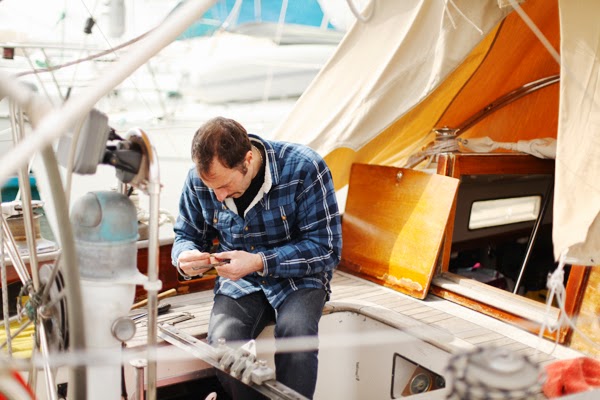
What you see in the image above is the frame of the new cockpit table that he's made in teak which has been glued and assembled, temporarily fixed to the saloon table. Going to be marvelous to finally have a proper table to dine on also outside. 

Spring projects continued


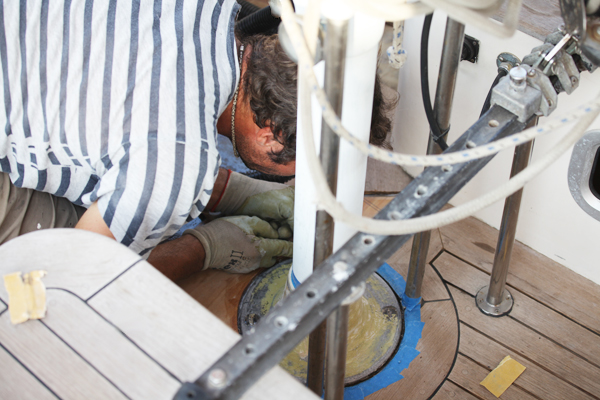
A partial re-decking and re-caulking of the cockpit is under progress. Alex replaced most of the margin board and a few other teak planks in the cockpit. The old caulking has been removed in the old seams. Seams has been re-grooved, sanded and cleaned. Tape is up and now re-caulking of the seams are being done before the final sanding of the teaks to new wood will take place.

We've had it rain free here for a few days now so cross your fingers it'll stay that way for at least another 24 hour. It's always a race against the clock and the weather for these sort of outdoor projects. And rain is definitely no stranger to New England. At least the awning gives shelter from minor downpours.

Next thing up after that:

Varnishing of coamings and cabin top sides. We've started stripping the old varnish off as you can see above. Varnishing is a life long project as you might know. Min. 3-4 coats x 2 a year for regular maintenance.

We once had a dream of owning a complete wooden boat, but the time we'd have to spend working on it just didn't seem justifiable. Our Duende (with glass hull, wooden deck, wooden coach roof and wooden interior) require just the doable amount of attention, it stops right before you actually begin to loose your mind. 

It goes without saying that the long cold, wet winter directly exposed to the weather wasn't the best of experiences for the wood so it can only get better from here onwards.

Here's hoping for a long, warm spring and summer!

Check in here for some of the work and restoration that has been done on the boat in the previous few years. 

signs of spring

The epoxy is back! Almost missed that tart smell. This period must've been the longest in four and a half years that we've had those bottles and cans stowed away from sight. But certainly happy that the weather finally allows Alex to asses the small leaks and needs of repair that has accumulated over the winter. 

These hand carved dutchmen are being fitted into place where rotten wood was removed in the quarter berth underneath that mainsheet traveler. One leak fixed, many more to go…. The charm of living on a boat.

alive again

Today it's been raining like a monsoon storm hit the coast of New England, but two days ago, this is what went down over here… Alex's first outdoor boat project in five months! Repairing around the bolts that hold the main sheet traveler, as the wood underneath had started to rot. 

Next up: checking other suspicious leaks and damages (many) caused by a long cold winter, and repairing all those, one by one. If only the rain could stop pouring down. That would make things a tad easier. If it's not one thing, it's always something else, non? 

Still very happy to get back to our "normal" live aboard life though after too many months in hibernation. Meaning, we are back to living full time on the boat again, and the warmer weather allows us to finally start living life like normal people, once again. Out of the dark, into the sun.

As you might know, we have stayed approx. 20% of our winter days and nights in the lovely little flat in Cambridge*, and the rest of the nights on the boat in this wonderful marina in Boston Harbor. But as spring is here and the coldest part of the season is behind us, we are again ready to spend 100% of our time in our floating home. Making her sail ready for the upcoming sailing season is now our first priority. 

I haven't shared many photos or stories from the boat these past few months as it's literally been too cold to shoot and write. I think I said somewhere earlier that we have had an average indoor temperature of 15˚C, but the truth is that many nights when outdoor temperature was far below zero Celsius, we couldn't have had more than perhaps 7-8˚C (45˚F) in the cabin - as that is more or less when you start seeing your breath, which was the case many a night. 

I remember a night when I woke up around 3am, limbs frozen, teeth shaking, and I had to go to the bathroom. Of course, the hoses and toilet on the boat was all frozen firm. So in the pitch dark, with a howling snow storm outside, -15˚C, I had to dress my already over dressed body and head out to the marina facility's restrooms outside. Half a mile from the boat. And I finally arrived after trudging through the snow on slippery icy wooden docks, but only to find out my frozen brain had forgotten the damn keys to the bathroom on the boat! 

It's definitely been an interesting time, an odd change and experience in life if you will, and I'm somewhat surprised at how good we've managed with the conditions we had to deal with. But it only proves to me again that human beings are ever so adaptable. We all are much stronger than what we might think that we are. It's really only the distractions and conveniences of our modern society and lifestyle's that have made us think we need a certain level of comfort. But life really doesn't have to be all easy and comfortable for us to survive. I think it is important and very healthy to sometimes step out of our comfort zones, literally speaking, in order to feel what life and real nature really feels like. How it was lived before we all got lazy and demanding.

Of course off shore sailing, riding through storms and living in the nature already gives you a sense of natural raw reality, but I'm also very glad we got this opportunity to feel how it is to live aboard in such low temperatures with all what it means. However cold and miserable it's been at times. And even if this was considered one of the coldest winters in history (we def. picked the right one!), I know it can be much much worse. Will think about installing a shrink-wrap if we ever find ourselves in something worse than this though.

All experiences that doesn't kill you, will not only give you valuable teachings and important life lessons, but it'll also give you a bunch of good stories to tell. For all those I'll always be very thankful.

*A massive thank you to Chris who let us stay in the apartment every now and then this past winter. You've been far too kind and hospitable and we owe you at least a week of sailing when you get back from your world trip next year! Let's hope we'll be somewhere much warmer by then :) All the best for you upcoming travels.

Dining table worked on

Good thing with being in a marina like this, is that there's a workshop available for Alex to finalize some of his projects. Can you believe that we have had this boat for 1, 5 years, and not before now has he had time to produce a saloon table? So you can only imagine what state the boat has been in and what other more critical things there has been on the to do list, for us to eat from our laps for such a long time. Time to finally take care of these more cosmetic and comfort details too. 

This recently done table consists of three cedar planks and a trim blind splined together. He's just spent a few hours sanding the surface and carving edges and corners. Going to adjust fittings now and then some varnishing to do before he'll be mounting it where it's supposed to be fixed above the engine cover in the saloon. Later on, probably someplace else when time allows, he'll add folding extensions to each side. One step at a time but it's looking good so far.

A well deserved pause

Oh sweet jesus, isn't this a sight for sore eyes then I don't know what is. All Alex's cans and chemicals are finally, after two months scattered about in our direct living space, been transferred back to where they belong. Neatly packed and stowed away under the seats of the sofas. It is a relief greater than what you can imagine. Life goes back to normal again now that he's done with the renovation indoors. Of course, all is never really done knowing that we live on a floating renovation object and there are so many smaller details to consider. But we can finally bid adieu to the tough part for this time around, and we'll welcome a moment of peacefulness before we move onto the yard and continue with the maststep. 

Cockpit sole is now remade, compression tubes are in place, the area around the sinks are repaired, sealed and re-varnished, the bulkheads are installed, the leak in the water tank is fixed, fittings and new scuppers on deck are installed and maybe I forgot something now. Will show images of these jobs shortly. Only being anchored rather than tied to the dock, gives us a brand new sensation. It's a thrill walking around on deck, inside and in the cockpit and sense how much more united the boat is now compared to only eight weeks ago. Those tubes and the bulkheads really made a big difference. We're still a bit nervous about how these new additions will adapt and feel when we're actually sailing, but we won't know before new mast step is in place as we don't want to tension the rig before that has been done. We (especially Alex) need some time of peace and tranquility before that new project starts though. Three years of almost non stop boat work and rushing through islands, he's starting to feel it. Complaining he feels old and tired, and having always been extremely active, he's now begging for a long quiet vacation. It's really a pity there are no clean and nice beaches around this city.

New cockpit

Teak was removed, cockpit sole was redone, planks have been glued back in place and teak is now prepared for caulking. Feels more firm and steady already and leak should be gone after this is finalized. So thankful that it never rains here in this city. This is the last blue tape on the boat by the way and it is nowhere to be found in Cartagena. Glad (not only for tape reasons) that we're soon getting visit from the US of A.

Additional installments

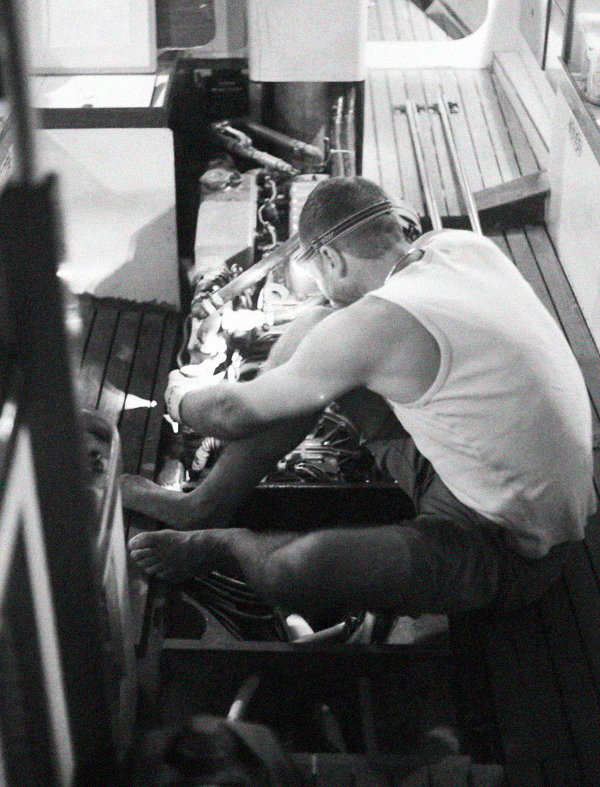
While the teak job in the cockpit is drying, Alex is now installing compression tubes from a new carbon floor he's done (located between his right foot and the engine in the image), to the beam above to stiffen the boat additionally. We just got the two stainless steel tubes with mountings welded and delivered and they shall be in place here shortly. Here he's adjusting the exhaust pipe from the engine so it all will room close to one another. There's normally an insulated table covering the engine, which is located in the middle of the saloon, right above the keel. That table will be redesigned one day too, when these first more structural and important parts are in place. You can see the compression tubes laying on the floor towards our cabin.

What is he now doing?

Fixing the smaller cockpit leak that we had. Sealing the floor and re-fitting the teak. Finally will our guests be able to sleep without water dripping down on their feet in the quarter berth. Michael did you hear that?!

Aftermath

Collection of the remainings of the gradual rig replacement we've done on the boat in the previous few months.. old pieces of stainless steel and bronze. Some of which had been on this boat for forty long years.

Soon on the dry

After a month here in Club Nautico marina, it's soon time to haul the boat up. This is how it looked last time in Antigua. We're still debating whether or not to cut a piece of the rudder aft and glass an extension to the skeg for more stability. The large swept back rudder gives us better control of the boat (which already has a lot of wether helm) but it also adds extra stress to the structure and the size of the rudder might have been one of the causes for the steering chain to snap (besides old chain). We would like to minimize the risk of having that happening again and also to as a whole, make the boat less vulnerable for external impact.

Another interesting/odd thing with this boat is that she was originally designed with two daggerboards coming out from each side of the rudder. They're now removed (we think! could still be inside of their housing) and the slots are covered and glassed, but we understand that those played a great part in stabilizing the boat back in the days. I mentioned before that the boat is extremely fast but slightly unpredictable and if you loose focus for one second, she's already pushing to the wind. That's also something we'd like to get rid of, or at least minimize the best we can. It's not like we got ourselves a ready to go kind of boat, rather a massive challenge and she's demanded many sleepless nights from our (mainly Alex's) part thus far.

We're anxious to get out test sailing her now after the recent job done on the bulkheads, and another one after she's been up on the hard and got her mast and possibly also the rudder worked on. New mast step is the first priority when we haul her up next week.

Almost there

Do you see what I see? Our bed frame is back up, this bulkhead has been faired perfectly even as well as been painted, and the doors to the wardrobes are also in place. Maybe a small step for humanity, but a big step for us. We can finally see this project coming to an end and we'll be sleeping in our own bed again very soon. Now remains only painting of the bathroom bulkhead so we can get back to taking showers on the boat again too. Step by step it's all coming together..

Update

And how's it going with the refit you might ask? Well, it's moving forward but having a perfectionist in the house, it always ends up with him improving every detail that he finds to be faulty so another project have just begun. The bulkhead between the head and cabin is done, only paint missing. But now it's the other cabin bulkhead where two of our wardrobes are located, that has got new plywood in between and is getting strengthen and worked on as we speak. Hey, why not rebuild the whole damn boat while we're at it!

Alex has also had time to install new carbon reinforced stringers or whatever you prefer call them, you can see one of them to the left. As well as reinforced the existing frames and floors with carbon too.

Honestly, I feel like retiring from this project right here and right now (having PMS as well) but knowing how much more Alex is sweating and suffering in that mask and in 100°F, I better keep my mouth shut.

High price for freedom and happiness

Since Alex ran out of Sicomin the other day (which he normally prefers working with due to its lower viscosity and better controlled working time), he has now went back to West System to finalize work on the grid and bulkheads. Luckily they had an importer for it here in Cartagena, were not exactly counting on it. 

The price is interesting though. I don't know how much exactly you pay for this in the US or elsewhere, but here the price for a kit of 1 gallon resin and 1 quart hardener is priced at $250 USD, 25% import tax included. It's almost the price as in Antigua which is overall super expensive, but St Maarten on the other hand offered this kit for $160 USD before discount.

For non boaters, just to give you an idea of how costly all things for a boat is, this combination of resin and hardener is used as the glue in the building process of structural installations, laminations, joinery and sealing of wood. Pretty expensive glue wouldn't you say? 

I think in the past fourteen months that Alex has spent time working on our boat, we have spent around $2000 USD only in glue, discounts included. Quite an interesting thought. Then there will of course add up with the cost of fiberglass, carbon, kevlar, wood, tools, mixing pots, brushes, tape, gloves and what else is needed - only to install missing bulkheads/walls. 

Number of brushes used in the same fourteen months is around 1000 until today, which each are sold for around $2 USD in the Caribbean islands. Gloves, 20 boxes consumed, cost per box $25 USD. More than 50 rolls of blue tape has been used, costing around $7 USD each. 

Will go through all of the bills of the complete refit one day when we have some peace of mind, but I'd say that there's at least a $20.000 USD spent only in material (no equipment) since we bought the boat. This process would have never been financially feasible if Alex wouldn't be able to do all the work himself of course, as we'd have to add up a minimum of 1000 man-hours to get the boat to the condition we need.

In general, the price for boat and marine material is around 50% higher than the counterpart for a house. The sailing lifestyle might be cheaper in the way that we normally pay no rent or other bills (except for when we stay or have to stay in a marina), but it's the maintenance and refit that's the heaviest part. 

It's a pretty common subject of conversation among boat owners, everyone are annoyed and complains about the ridiculously high costs of keeping their boat in shape and not to mention the hard physical work they put into it, yet we still keep on living this life. I have very much respect for the ones like Alex who sacrifices so much of their time and mental peace to get one boat safe and strong, but sometimes I can't help but think it's a bit perverted. Almost like they have some sort of self-hatred, to be able to go through all that pain.

I guess it will be all worthwhile in the end though. There's an enormous sense of accomplishment and pride that naturally comes with having done things with own hands rather than buying something new. And since one of our larger dreams is to bring Duende to the Mediterranean and get ourself a run down house by the water - a house to renovate and decorate to match our standards, we just gotta keep up with it. I hope we will then appreciate the fact that the material for a house will be at least half the price of the same for a boat.

FYI: Alex grew up with a grandfather who taught him joinery. He built many scale boats and planes, as well as rowing dinghies and a small catamaran when he was younger. During his surfing years he glassed many surfboards, and later on he built his own mastering and recording studios - so it's not like this is anything new to him. He simply loves the building process no matter how hard or daunting it might seem.

Bulkhead up

All plywood parts are ground, grooved and shaped. Here spreading the filler into the grooves. 
Alex chose to carve out grooves in parts of the plywood to achieve a better mechanical bond, particularly in places where it will be hard to glass around. Like on the level of the drawers, as we had no will to dismount and tear apart the whole interior.
Another biscuit joint to bond the existing half bulkhead with the new extension.
Mixing up more filler.
Screwing in place.
And there the whole new bulkhead is up. Almost done now. Now remains only carbon tape and fairing, before painting and a mahogany trim that is going to be installed. More to follow...

Renovations

Some of you have requested a look into our cabin. Here it goes. Cozy, no? So there you have two half bulkheads, one ending by the toilet bowl, the other by the drawers to the right, both connected with a strong beam at the top, but only a thin (and rotten as we found out) floor by the hull. There has also extended an 8 mm/0.3 inch thin plywood plank which was simply attached with five screws, loosely closing the toilet from the cabin but that is now removed. A new strong extension to these half bulkheads as well as a new floor, is being cut and grind as we speak. It will basically be a full bulkhead here when it's done and this little addition will naturally strengthen the boat even more, plus give more privacy to the cabin once it's all set. I will give you more technical details and images a bit later.

It goes without saying that we do not sleep in there at the moment, but instead we're making use of one of our two guest bunks, those that normally fit around 1,5 people each. Very sweet, especially cozy it is to be that close to one another when Alex has again adopted the wonderful smell of fiberglass that has stuck into his pores after grinding parts of the inside of the hull. That familiar smell which is almost impossible to wash away unless you swim in boiling water. Hot water that is such a luxury and not so often encountered these days. But we're pretty happy nonetheless. Last night we were so exhausted though that we both fell asleep in that tiny temporary cabin with the laptop on the stomach in front of this old movie. At least it proved that we are flexible as to where we sleep. Only a couple more days left of this mess now..

Slowly transforming

While I am normally busy editing images or reading my Spanish books in the evenings, as a part of my regular every day job and general education, Alex is often glued to his yacht design books or busy drawing new plans for the boat. Many sleepless nights have been spent on his part since we got Duende and still there's a long way to go before we for sure know that this boat is as safe and seaworthy as we need her to be. Why is Alex building new frames, floors and bulkheads you might ask? Doesn't every sailable boat come with them already in place? Yea, one would hope that at least those are where they should, but somewhere along the line of owners since Halsey Herreshoff sold his designed race boat (in which he himself sailed and raced in the mid seventies) - there has been some alterations done by different hands. We've earlier mentioned that the interior is beautiful to look at, but unfortunately while that new joinery was put into place some ten or fifteen years ago, many ribs, frames and bulkheads have simply been cut and removed to make room for new installations. Like I said, the interior looks beautiful at most parts and it's well made from an artistic point of view, but because we want and need a seaworthy boat, these alterations were the first ones on our list to be repaired. 

I have also mentioned before that we have experienced some flexing of the hull while sailing, and that obviously comes from the lack of a solid, strong structure, which was somewhat destroyed by the alterations that have been done in recent years. As you might know, Alex has now spent the first year with this boat restoring the missing bits and pieces. There are the new stringers and frames under the aft cabins. A new chainplate and framing has been added to the transom. During the haul out in Antigua last year, Alex added a few new floors in the mid-section, in front of the mast under the head which I have yet to show you. There are the floors, bulkhead and frames that've been built at the bow, as well as the latest structural addition added under the companionway. This means that most of it is now done and the boat feels stiffer and stronger by the day, but there still remains two very important jobs to be completed before we can fully trust and feel confidence in this boat. One of those are to rebuild the steel mast step, and the other job which Alex just started: to extend the half bulkhead which is in front of the mast in between the head and our cabin, to a full bulkhead to give more stability. There certainly is a big job in restoring this boat to her original glory as well as to add the extra features which slowly transforms this yacht from a light and fast race boat to a, still fast, but also safe and seaworthy offshore cruising boat. I am currently sorting out the photos from the past years refit and will soon show you all steps from the above mentioned work that Alex has put into Duende thus far. 

Work in progress

Cutting the long chain in two. One part is being installed now and the second part will be kept as a spare should this ever happen again. You see that enormous swept back rudder in the water? It's the largest rudder we've ever seen on a 43 feet boat. Contemplating on having it re-designed. The boat was made to race and that fast, but some of the racing benefits that are on this boat, are not that suitable for safe cruising. We can easily make 170-180 miles per day with her even when fully loaded with water and fuel in the tanks plus all our belongings and extra crew on top of that, but she can also be very demanding to sail. 

We call her the Arabian horse as she's so beautiful, gracious and extremely fast, but at the same time she's a tad nervous and reacts at the slightest change of wind. Do we ever regret selling the old safe Hallberg Rassy 352, readers sometimes ask. And while there's no time for regretting, there are things we knew from the very early beginning when we found her, that we would need to have altered to make this beauty into a somewhat safe and sound cruising boat. Alex has done so much already in the past twelve months, but there are still many more details that we need to have modified and rebuilt before we are ready to cross the Pacific. 

We're planning on spending a month or so on the hard in Colombia to prepare the boat additionally for that long ocean passage. One of our greater dreams is to bring Duende to the Mediterranean where we imagine her belonging the best. Still a long way to go...

Read here to see what happened to the old chain / Emergencies at sea.

New coamings

While most of the hull reinforcement job is done (will show more photos from it one of these days) there are still a long list of smaller things to take care of on the boat. This is what Alex has been occupied with the last couple days. He removed some old wood inside of the coamings and replaced it with plywood and cedar. Luckily the outer part made of mahogany was intact so only neccesary to deal with parts of the inside. It's almost done now and Alex will be glassing it tomorrow. Little by little he's ticking of tasks from the long list..

Stringer and bulkhead job aft bunks

I started project "reinforcement" to avoid high point load and because the boat was flexing a bit too much. This was clear from day one when we purchased the boat so I knew I just had to dig into it... Here in one the two aft bunks. I have here removed a rotten mini bulkhead/frame which also wasn't tabbed properly. I've grinded a large area for the new stringer and the new bulkhead that I planned to put in here on each side. 
Cutting plywood/new bulkheads.
1/2" marine plywood.
Night has arrived.. cutting stripes of foam for stringers.
Four layers of each around 10 mm stripes of foam glued together and glued to hull. This is before shaping.
Shaped and in process of filleting with epoxy and filler.
One layer of Biax and one of UD. 
Here's the stringer finished before painting. That's two layers of Biax, three of UD and I used Peel-Ply partly to avoid having to sand before painting.
Morning after, bulkheads to be put in place. I've cut some vent through them and shaped them by the corners.
Glued and fillet.
Tabbed and plywood sealed.

Haven't painted the area yet but shall do so when all floor work is finalized. Boat is slowly feeling stiffer with this and the other recently done reinforcements. Showing you the other parts shortly. /Alex