Showing posts with label Food finds. Show all posts

PB&J

I guess also most of us non-Americans have heard about the infamous thing called peanut butter and jelly sandwiches, even if we haven't tried them out personally. And why would we? Isn't it only Americans who eats such weird compositions? Surf and turf (lobster with steak, hello?), apple pie with american cheese on top (excuse me?), and a sandwich with peanut butter and jam, eaten in one go? You've got to be kidding me.. 

I had always thought such nonsense belonged to Americans and Americans alone and I had never ever had the intention to try that sort of sandwich out whatsoever. But that was only until the day that I actually saw somebody (read: our friend that we live with) preparing such a meal (yes, people eat these things as a substitute for lunch or even dinner from what I understood). And since it was there before my eyes, I figured why not give it a chance, how disgusting could it be on a scale from one to ten. My motto is anyway that one should always try everything out at least once so one knows what one's talking about. That goes for almost everything in life I would say, also things involving peanut butter (but maybe not apple pie with cheese-burger cheese, eh?).

So anyways, I started with one small bite and as I moved the weirdness to my lips I was totally sure it was both my first and last bite of this filthy American invention. And I truly wish, for whatever vain reason, that I could say it tasted as horrible as I had always imagined, but it didn't. It didn't taste bad at all. In fact, it tasted very good. Now, it has probably something to do with the quality of the only three ingredients. Would it have been a pb&j sandwich made with white toast bread which is a totally useless product in itself, and a corn-syrup filled sugar bomb to jam - my first ever experience with this phenomenon would probably have been a lot worse, and I wouldn't have to crave these things ever again. But the particular sandwich that I got introduced to was made with the best homemade wholewheat bread straight from the oven, natural organic peanut butter, and a favorite French strawberry preservative with zero corn-syrup and only natural ingredients. All three elements brilliant by themselves, but who knew they'd be that compatible in a threesome. 

I probably shouldn't be eating this stuff too often, but I can admit my prejudice and that I had judged without any first hand experience. Sorry America, once again you've surprised me. 

Two lessons learned: 1. Never judge someone or something before you actually know what you're talking about. 2. Quality and presentation is everything.  I'll leave the final words to Albert Einstein: 

“The mind that opens to a new idea, never returns to its original size.”

Fruits en masse

Great thing here in Colombia is that you can get a hold on fresh fruit from close to any street corner. There's always a vendor ready to supply you with sweets in any shape and color and the price is always very good too. Lulo, pineapple, mango, granadilla, uchuva, guanabana, carambola...
But what are these? I forgot to ask and can't figure out which one it is. They're small in size, smaller than a kiwi and the vendor continuously sprayed them with lime juice to keep them fresh.. Anyone knows?

An angelic cake

Let us talk about sweets again, you know I love it. 

Every country and continent has their own cakes and bakes that both small and big kids run to the store for. Caribbean is known for coconut cake in hard or soft version, guava cheese and rum cakes. In Sweden the cinnamon rolls are a household necessity alongside chocolate balls as well as the brownie these days. France boasts with exquisite lemon tart, almond croissants, macarons and a wide array of other extraordinary desserts. And in Spain you'll be foolish not to try flan, turrĂ³n or crema de limon. 

What about Colombia? Well, the Dulce de Leche is widely used as I mentioned and can be found within and on top of approximately 70% of all dulces and postres, but there comes a time when the flavor of arequipe starts to bore you, at least if you haven't grown up with the taste. When that happens, it might be hard to find anything else of interest - but that's only until you get introduced to these bad boys. 

Let me introduce to you the Pionono de crema. 

What are these things? 

Technically they aren't more than a jelly roll, a sponge cake made of eggs, sugar, flour, baking powder and perhaps vanilla - and then filled with whatever takes the bakers fancy. 

Naturally, you'll find these Piononos filled with dulce de leche/arequipe/manjar blanco - as that's what most desserts are filled with remember. But it can so happen that you run into a Pionono made con crema. Now, this specific cake on the picture doesn't in fact remind much of a typical sponge cake rolled around in a cylinder as you might know them, but it's because it's turned upside down and baked in a slightly different shape. But let's not loose focus on what really is important here: the filling and topping of this cake. 

We were walking on one of the narrow cobbled streets in Getsemani when I heard Alex mumbling "I need something sweet" - when that normally happens, we have like ten minutes to find something before he starts to get moody (diabetes warning anyone?) We walked across the street towards a tiny bodega we've never seen before. "Whatever they've got, no more dulce de leche for today" I responded hurrying after. Inside of the dark mini market with walls stacked with cans of food and bottles of rum we found it. With an angelic presence in white attire they lit up the dark room and we just knew what was on order. Two of those please!!

After that I don't remember much, just that we continued our walk, each mouth full of cake and all of a sudden we looked at each other. What was that? Do we remember the name of this street again? Will you find here if we need more?

After our day in the historic center, we did find another little bodega that served them, though for double the price and with less intense flavor so I guess we'll soon be back in Getsemani looking for the very same tienda.

I've googled the cake and found out that it's pretty hard to find Piononos that isn't filled with dulce de leche. But I think I've finally understood that this rare, but oh so divine filling is a simple mixture of milk, lemon zest, egg yolks, a bit of maizena, a dash of rum, and then topped with a bit of cinnamon.

They might not look much to an unskilled eye, but believe me when I say that the sweet softness of the cake mixed with the flavors of the filling combined with the cinnamon on top are out of this world. I'm also happy to announce that the boat is now in order so I can finally start baking myself again. It's been a while.

In search for the perfect Dulce de Leche

Sweets and desserts is a weakness of ours. Ice-cream, pastries, cookies, sorbets, buns - whatever that is well made and contains sugar really. Except for perhaps guava cheese or tamarind balls.. Here in Colombia as well as in the rest of South America, dulce de leche (also called Arequipe) is a popular thing to add inside or on top of desserts. You'll find it as an accompaniment to pancakes, inside of buns, cookies or cakes, you can spoon it up from a box in hard version and eat it as it is - or have your waffles floating around in it. In many parts of South America, Argentina especially, the basic dulce de leche is sold in any supermarket, served as a part of desserts in every restaurant and is loved by almost everyone. It's a part of their culture as much as coffee is.

Dulce de leche which literally means the sweet of milk, is similar to what we would call caramel elsewhere though it's even closer to the French confiture de lait. The basic traditional dulce de leche recipe calls for nothing more than milk sweetened with sugar, but the quality and way of preparing it differs naturally from place to place, kitchen to kitchen. It's the sort of thing that is absolutely divine if done right, but can also be a mere dull sugar bomb if you're unlucky. The real good ones I've tasted in my life consist also of vanilla, a bit of salt, and even cinnamon at times. 

Restaurant Crepes and Waffles gets 2 out of 5 dulce de leche stars from us today. The waffles were good but the caramel offered merely a basic sweetened-condensed-milk-in-the-micro-oven-kind-of-taste. Best in town so far must have been that cake we had the other week at Mila which could reach a 3,5 to be fair. 

If you'll ever try your hands on making your own dulce de leche, I would recommend making it with real whole milk and add your own sugar rather than using canned sweetened condensed milk which so many websites suggests. And don't forget to add a good amount of fresh vanilla seeds, at least that's what I would do. Am going to experiment with my own version and will let you know how that goes.

Hallelujah moment

The feeling when you discover you had forgotten
that you still had some Dutch licorice left in the back of the storage...

Colombian chocolate

Good but nothing still come close to the quality of the one from Grenada...

Venezuelan avocados

Went into the capital Willemstad today to fetch some fresh fruits and veggies and that's where the floating market comes into the picture. Venezuelan fishing boats have traveled the thirty-fourty miles there is between their coast and the one of Curacaos'. Side by side they've tied up to the dock by the boardwalk and sell fruits, vegetables, juices and what else typical Venezuelan there is, right off the boat towards the street, hence the name "floating market". We got a couple of those enormous avocados (have you ever seen them that large before?), a water melon, bananas, dulce de leche as well as some guava jelly. Speaking of Venezuela, we did spend a night there on our way to the ABC islands a couple weeks ago. I have yet to tell you the whole story. Some weeks I have all the time in the world to ramble here on the blog several times a day about all kinds of nonsense, and some weeks, like now most recently, I have barely time to reply to emails. We still have a lot of sailing to do, and some island exploration of course. As well as the necessary boat work and other important job that keeps us busy, but all should slow down a bit very shortly. We love this island by the way, Curacao reminds of Europe in many aspects, mixed with latin and carib flair, and it's all very busy and bustling. Totally not what we had expected. Will show you more of it shortly.

The Grenada Chocolate Company

This is some seriously good, high quality stuff. Grenadas own organic dark chocolate... the crispy one called "nib-a-licious" with a hint of citrus, banana and dried fruit is out of this world.. If you'd be interested in trying out something new, get on their website where you can buy it online. I love the colorful packaging too..

Carambola

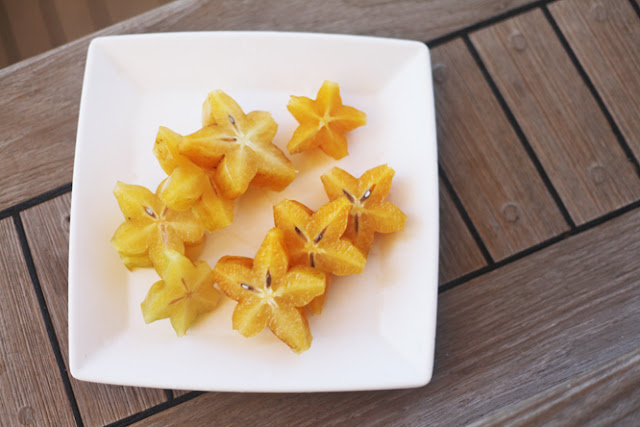
Starfruit is also a local fruit that we love very much. Sweet, tangy and very juicy. Great to eat as it is or mixed into a healthy juice. And of course it is also very beautiful with its starlike appearance. If you never tried it, I could try describing the taste as something tart and sour a bit similar to a young granny smith apple, while bearing a sweet juiciness close to the one of a mid summer orange. 

One sexy fruit

It might not be very easy to get a hold on ruccola, european cucumber or all the fresh herbs whenever you long for them here in the Caribbean, but there are obviously other lovely fruits and veggies on offer. Like Soursop for example. The man who sold this fruit to me today claimed with a content smile that "soursop will help you get babies faster". Not sure why everyone is insisting on me getting babies these days so I told him politely that having one is none of my close plans whereupon he came up with another interesting claim with, if possible, an even wider grin "well it will at least give you more fun while practicing!". Whatever it does to you, the soursop is a damn good fruit. Similar to cherimoya with its white flesh and black seeds and taste lays somewhere in between lime, pear, pineapple and strawberry perhaps. Sweet, soft and tangy. Great to eat with a spoon once you've cut it in half or to squeeze it into a nutritious juice or why not into your morning smoothie. 

street food

Crabs for lunch, anyone?

Pink pamplemousse

Almost the shade of figs. Still a bit sour, should get sweeter in some weeks. Remembering when we arrived to the Caribbean earlier this year and the (yellow) grapefruits were so sweet and juicy that I thought I had mistaken what fruit I was eating. They grow almost all year around here in the West Indies, but they are at their best between Dec-March.

Weekly supply

Loving the fact that you're able to get your needed vegetables, fruits and herbs literally straight from the ground and the trees here on these lush, green West Indian islands. We have one friend here in Antigua who harvests his own garden and delivers a colorful bag of our favorite produce once/twice a week and it is always full of amazing fragrances and flavors.

This time he got us some yellow lime fruit, one large avocado, lemon grass (making my own amazing lemon grass tea) and fresh basil with flower. Boat smells wonderful with all this beauty around.

West-Indian fast food

In other countries one might go to Mc Donald's, Subway, the local kebab or schwarma house or perhaps a pizzeria when the laziness wins over the desire to cook - here in the Caribbean you make sure to get yourself a spicy roti. Roti* was introduced to the Caribbean as early as in 1840 by Indian indentured laborers. A little side-note to the story for the ones of you who don't know this yet; after the slavery was abolished in the Brittish empire in 1833, plantation owners had to turn to indentured servitude to get inexpensive labor. These servants arrived from all over the world, the majority came from India. In fact that much, that from 1846 to 1932, an estimated 28 million Indians arrived to work in colonies requiring manual labor. Of course these people have influenced the West Indies in many ways with their culture and also their food and this specific dish that I'm talking about, was first introduced in Trinidad and Tobago, and has with time spread to other Caribbean islands.

The roti is a form of flour pancake/crepe/wrap and it is filled with either stewed chicken, lamb, channa (chick peas), beef, conch and/or vegetables. Curry is often included in the mix or choose to have it jerk style or with a spicy creole sauce. However you want it, it is always very very spicy. Make sure you try one out next time you're around, it is all very simple yet incredibly tasteful. Curry chicken is my personal favorite.

*In other parts of the world, Asia for instance, the name roti is used for only the flat bread, without the fillings.

5 favorites bottles from the West Indies (and I ain't talking rum this time)

There are so many delightful recipes to get inspired from here in the Caribbean and they all have a bit of sting which is always very welcome. Best way to collect and keep these wonderful flavors for the days when we're no longer here, are to stock up on your favorite sauces on bottle. I'm sure most of these can be found in other variations around the world, but these are my five favorite Caribbean bottles of joy that I have came to love during our stay here in the West Indies:

Garlic Sauce - Simply a bottle full of garlic. I'm addicted to this shit. Just opened our second bottle in less than five months so you can only imagine how good we smell around here. Can be used for everything and anything.

Passionfruit sauce - A delightful, creamy sauce based on passionfruit but which also contains onion and salt to balance out the sweetness. This one is perfect for BBQ marinades and salad vinaigrette's. 

Coconut oil - Can come handy instead of olive, sunflower or whatever oil you're used to cook with but I use this mainly for baking due to its wonderful light sweetness. It doesn't have any coconut flavor as one might assume, only a very tiny hint of something reminiscent of vanilla, or nuts perhaps.

West Indian Hot Sauce - Just as the name suggests. This is a very very hot yet marvelous sauce that I add into most of my concoctions. Chicken stew, meat casseroles, thai mahi mahi and so on. This sauce is filled with the explosive bonnet peppers so be careful with how much you add to your food..

Green Seasoning - Another true Caribbean classic. A great supplement to any dish. This sauce is based on papaya, onion and peppers making it quite round in flavor. It is much lighter and a bit sweeter in taste than the previous, perfect when you're having visitors who are not too fond of entirely burning hot food.

Conch for lunch?

Yes please. Half a kilo, freshly caught, 7 Euros (if you're too lazy to pick them up from the bottom of the sea yourself, that is). Curry conch in the making....

You know you're in St Lucia....

... when your counter is filled with ugly looking grapefruits and speckled bananas. But do not let the appearance fool you, these grapefruits are the sweetest on earth and the bananas are sweet and firm with just the right amount of spiciness in them.

Price: 20 XCD for 6 huge pamplemousse and 8 large bananas (that's equivalent to around €5, $7,50 or 45 SEK)

Galley friend

These miniature bottles of rum that people left here or I don't know from where we got them, comes very handy in the kitchen. Instead of opening the big bottles, I use these little bastards to add a few drops in the cakes that I bake, in my West-Indian chicken stew, in fruit-salads, over grilled vegetables and every thinkable concoction that could be in need of some sweet improvement. Very practical as there are only very few things in life that wouldn't taste better with some rum mixed with it.

Chocolate in the making

There are many ways to save money and great possibilities to stay self sufficient when sailing the seas. You could make your own chocolate for example. That's just what Alex is up to at the moment, drying the cocoa beans (from the cocoa fruits we got in Dominica the other day) in the sun while we're sailing towards St Martin. Perfect day here by the way. 14-16 knots of wind from E-NE, flat sea and blue skies. Arriving to our new boat tomorrow afternoon.

Daily purchase/fruit shopping in Saint John's

Pineapple, mango, tamarind, soursop, orange, kiwi, banana, starfruit, melon, sugar apple, papaya....